
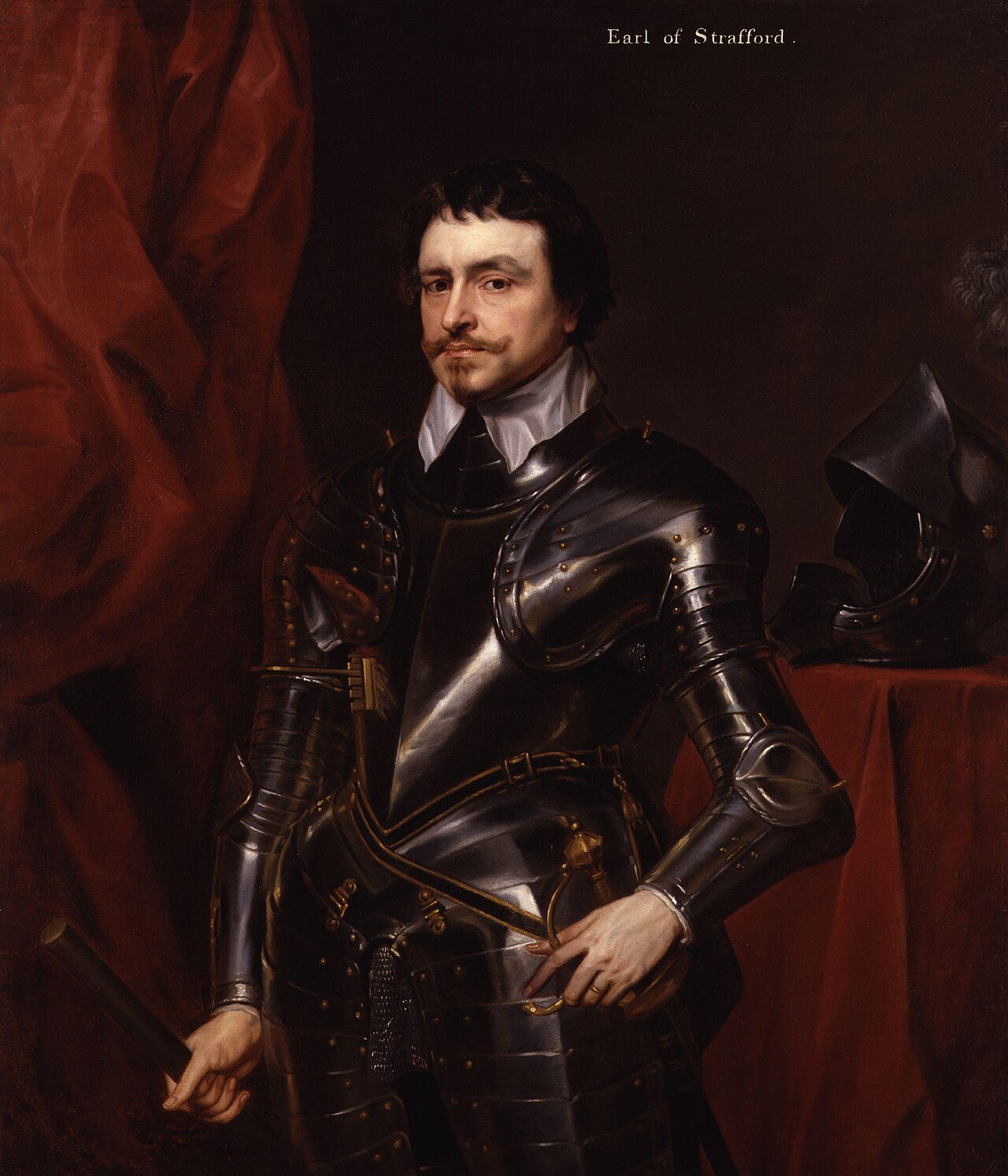
Thomas Wentworth was born in 1593 into a Yorkshire family of consequence. Educated at St John’s College, Cambridge, and trained at the Inner Temple, he entered Parliament as a young country gentleman and became one of the most formidable political minds of the early Stuart age. His first public instincts were independent, resisting forced loans, defending the liberties of the subject, and supporting the Petition of Right. He also believed that the Crown, being more than an office of convenience, was the keystone of public order.
Wentworth’s later service under Charles I made him President of the Council of the North, the royal council at York charged with government in the northern counties, and, from 1632, Lord Deputy of Ireland. There he sought strong government, obedient administration, disciplined revenue, economic repair, and the recovery of royal and ecclesiastical authority. His rule brought order to a kingdom badly governed and badly used. It also made him hated by those who had profited from weakness, faction, and local license. To admirers, he restored sinew to offices grown slack. To enemies, he made royal government effective enough to be feared.
Recalled during the Bishops’ Wars, Charles I’s struggle with the Scottish Covenanters over episcopacy and royal authority, Wentworth became one of the king’s principal counselors and was created Earl of Strafford in 1640. The Long Parliament, summoned in crisis and soon determined to break the king’s strongest ministers, moved against him almost at once. The Commons impeached him for high treason before the Lords. When the impeachment faltered, his enemies turned to an act of attainder, a legislative condemnation that dispensed with the ordinary protections of trial. Strafford was condemned as a danger to the fundamental laws of England and Ireland.
Charles had promised to protect him. Strafford released the king from that promise as public pressure grew, choosing death rather than force the Crown to spend its remaining authority in the preservation of his own life. On 12 May 1641, he went to execution on Tower Hill.
His courage demands respect. His enemies used the forms of law to destroy a servant of law and abused parliamentary authority in the name of liberty. Strafford understood that order is not self-sustaining. Offices decay when no one will bear their weight, and institutions survive only when men are willing to govern through them, suffer for them, and accept public office as a burden rather than grasping after honor.